


 The French directory of specialty vape shops that are independent of the tobacco industry

Analysis and interpretation of the results of the survey conducted in April 2026 by OpinionWay on behalf of FIVAPE among the French public.
Introduction
As it did in 2025, on the occasion of World No Tobacco Day, FIVAPE commissioned OpinionWay to conduct a study on the French public’s perception of the relative risks of vaping versus smoking. FIVAPE thus took over from various organizations: Santé publique France from 2014 to 2017, SOVAPE from 2019 to 2023, and INCa in 2022 (results identical to those of SOVAPE).
Thus, we have 12 years of data on how the French public perceives risks.
The methodology and complete results of the OpinionWay study are available in the appendix at the end of this analysis.
Context
Risk perception must be viewed in the context of what we know about vaping and its impact on smoking. Over the past 15 years, our understanding has grown stronger, and the science offers reassurance:
- Smoking Rates Are Declining in France1;
- Smoking rates plummet among young people2 ;
- One in two French people who have quit smoking say they used vaping to help them3 ;
- Vaping is recognized by scientific consensus as an aid4 in smoking cessation, twice as effective as nicotine replacement therapies and without any different or additional side effects5 6 ;
- Institutions recognize that vaping is less harmful than smoking7 and scientific studies8.
The positive impact of vaping is undeniable.
ANSES Report
ANSES, a health agency under the Ministry of Health, submitted its scientific report on vaping—more than 700 pages long and the result of three years of work—to government authorities in December 2025: “Assessment of Health Risks Associated with Vaping Products—Understand, Evaluate,Protect9.”
This report confirms that vaping is one of the most effective tools for smoking cessation—in fact, twice as effective as nicotine replacement therapies. It confirms that while vaping is probably not harmless, it remains vastly less harmful than smoking: there are no proven adverse effects, compared to those associated with cigarettes, such as cardiovascular and respiratory diseases and cancers.
Consequently, ANSES recommends not imposing a surtax on vaping products, not banning flavorings but rather regulating the molecules—or even setting standards—and not discouraging pregnant women who have been unable to quit smoking using other methods.
In its report, ANSES also addresses the issue of risk perception: “According to the latest Cancer Barometer (2023), the majority of the general public perceives the risks associated with e-cigarettes as equivalent to or greater than those associated with smoking tobacco. This perception runs counter to the conclusions of this expert assessment. It is therefore important to communicate and disseminate the findings of this report to various segments of the population.”
However, the February 4, 2026, press release regarding the ANSES report did not reflect its content at all, leading to numerous false claims in the media and sparking a large number of reactions10.
The OpinionWay survey commissioned by FIVAPE was conducted just two months after this highly alarming media coverage of vaping. It is reasonable to assume that this coverage influenced the results, thereby pointing to the direct responsibility of public authorities and their communication efforts regarding the public’s perception of risks.
Results
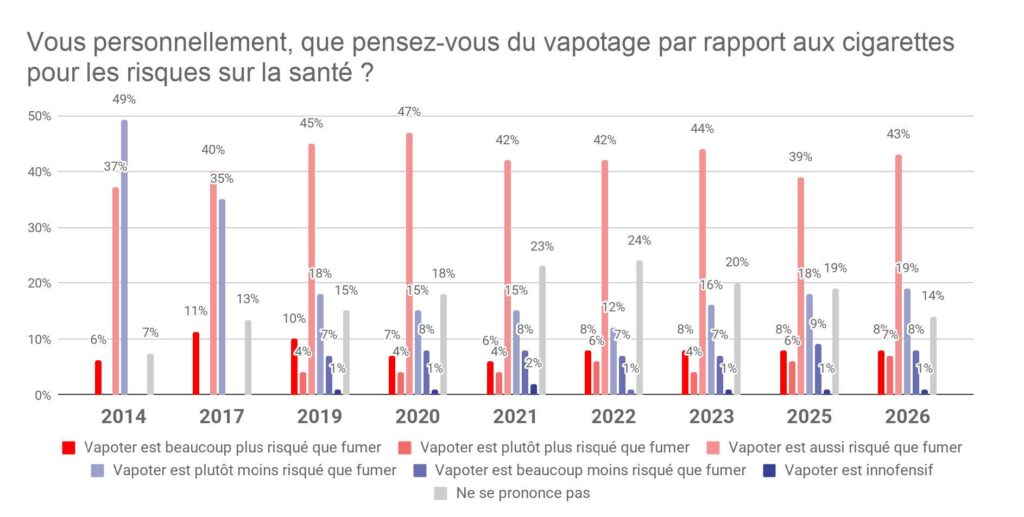
The 2026 OpinionWay study reports a very sharp decline in the perception of relative risks between smoking and vaping:
- 15% of respondents believe that vaping is riskier than smoking—a record high not seen since 2014
- Among 18- to 24-year-olds, 33% (one in three) believe that vaping is riskier than smoking, which is an increase of 11% compared to the 2025 study (see detailed results)
- Among 18- to 24-year-olds, 33% (one in three) believe that vaping is riskier than smoking, which is an increase of 11% compared to the 2025 study (see detailed results)
- +5% compared to 2025 believe that vaping is just as risky as smoking, or 43% of respondents
- 58% of respondents believe that vaping is no less risky than smoking (or even riskier)
- When you add the 14% of people who did not express an opinion, 72% of the French population—or 3 out of 4 people—are unaware of the reduced risks associated with vaping compared to smoking
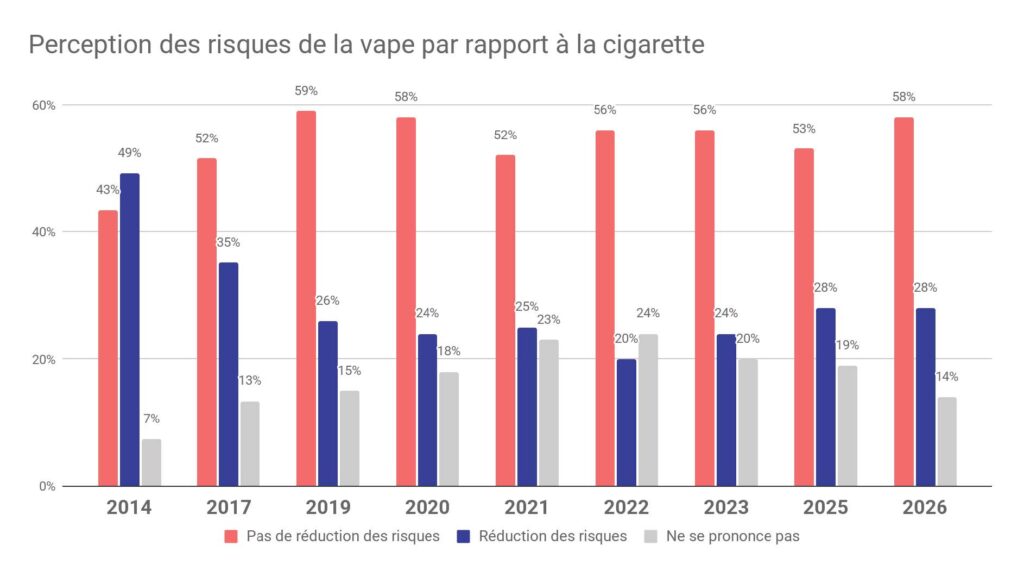
The level of misinformation among the public in 2026 is on par with that of 2019–2020, during the EVALI international crisis11 . The shift is particularly abrupt and reinforces the hypothesis that this is a direct consequence of a communication campaign—orchestrated with great fanfare around the release of ANSES’s report earlier this year—that ran counter to ANSES’s conclusions.
Although scientific knowledge about vaping was limited in 2014, 1 in 2 French people (49%) still believed that vaping was less risky than smoking. Twelve years later, after thousands ofStudies and an indisputable consensus on harm reduction, fewer than one in three French people (28%) still believe that vaping is less harmful than smoking: the gap between perception and scientific reality is therefore widening.
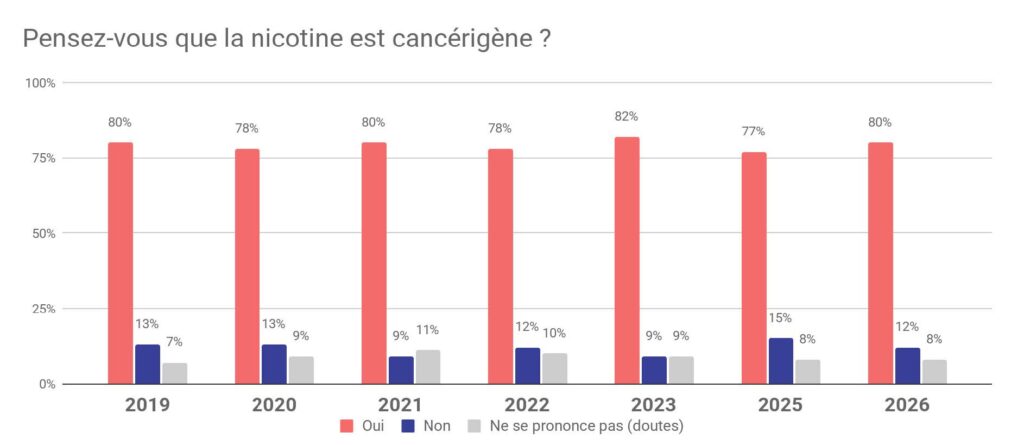
On the issue of nicotine, the results have also worsened and are staggering given the established scientific facts: 4 out of 5 French people believe that nicotine is carcinogenic.
This perception is the result of widespread misinformation that effectively hinders smoking cessation efforts, whether through vaping or the use of nicotine replacement therapies—which are, in fact, medications prescribed by healthcare professionals and covered by social security.
To remember:
- A record level of misinformation not seen in 12 years
- 15% of French people believe that vaping is more risky than smoking
- The figure is 33% among 18- to 24-year-olds, an increase of 11% compared to the 2025 study
- Three out of four French people are unaware that vaping is less risky than smoking
- Four out of five French people mistakenly believe that nicotine is a carcinogen
Conclusion
The French public’s perception of the relative risks of smoking versus vaping is undeniably inaccurate, given the scientific evidence that ANSES outlined in great detail in its report.
Moreover, not only is this perception mistaken, but it is also deteriorating sharply—in contrast to the scientific realities, which are becoming increasingly solid and reassuring.
While advertising and propaganda regarding vaping are prohibited by law, the responsibility for this widespread misinformation lies entirely with public authorities. It certainly leads many smokers to not consider vaping as a tool to help them quit and may also discourage the many “dual users” (vapers who also smoke) from quitting smoking entirely.
- Sharp decline in smoking in France: 4 million fewer daily smokers in 10 years – https://www.santepubliquefrance.fr/presse/2025/forte-baisse-du-tabagisme-en-france-en-10-ans-4-millions-de-fumeurs-quotidiens-en-moins ↩︎
- Drug use in Europe at age 16 - ESPAD 2024 results - https://www.ofdt.fr/publication/2025/les-usages-de-drogues-en-europe-16-ans-resultats-espad-2024-2608 ︎
- Attitudes of Europeans towards tobacco and related products - https://europa.eu/eurobarometer/surveys/detail/2995 ︎
- Electronic cigarette for smoking cessation: a fast-track Delphi consensus of French-speaking experts – https://link.springer.com/article/10.1186/s13690-025-01725-x ↩︎
- Can electronic cigarettes help people quit smoking, and do they have any adverse effects when used for this purpose? - https://www.cochrane.org/fr/evidence/CD010216_can-electronic-cigarettes-help-people-stop-smoking-and-do-they-have-any-unwanted-effects-when-used ︎
- Electronic Nicotine-Delivery Systems for Smoking Cessation – https://www.nejm.org/doi/full/10.1056/NEJMoa2308815 / Electronic Cigarettes for Smoking Cessation — Have We Reached a Tipping Point? – https://www.nejm.org/doi/full/10.1056/NEJMe2314977 ↩︎
- E-cigarettes: an evidence update – https://www.gov.uk/government/publications/e-cigarettes-an-evidence-update ↩︎
- Comparison of the chemical composition of aerosols from heated tobacco products, electronic cigarettes and tobacco cigarettes and their toxic impacts on the human bronchial epithelial BEAS-2B cells - https://www.sciencedirect.com/science/article/abs/pii/S0304389420314060?via%3Dihub ︎
- Assessment of Health Risks Associated with Vaping Products – Understand, Assess, Protect – ANSES Opinion – Collective Expert Report – December 2025 – https://www.anses.fr/system/files/TABAC2023-AUTO-0223-RA.pdf ↩︎
- Following the repeal of Article 23 and the publication of the ANSES report, France’s vaping policy must be redefined –
https://fivape.org/newsletter-fevrier-2026/ ↩︎ - A Look Back at the 2019 Wave of Lung Diseases in the U.S. (EVALI) – https://www.sovape.fr/evali-pneumopathies-2019-usa/ ↩︎